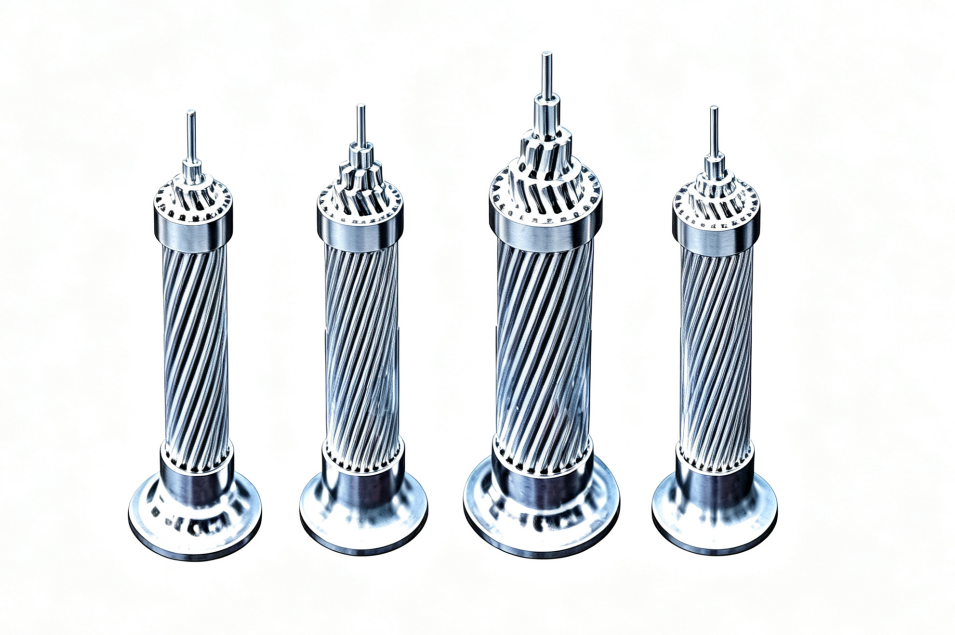
Bare wire refers to metallic conductors without insulation and sheath layers. It is mainly used for overhead transmission lines, substation busbars, earthing systems and connections of electrical equipment. Widely applied in overhead main power lines, distribution poles, switchgear busbars, lightning protection and grounding projects.

1996
160000㎡
10+Years
No.33+
The performance of a Bare Overhead Transmission Wire depends not only on its manufacturing quality but also on how the conductor is handled and installed. Excessive pulling tension, improper stringing equipment, contact with sharp surfaces, or uncontrolled bending can damage individual strands and create localized mechanical weaknesses. Such issues may not always be visible immediately but can affect long-term reliability after the line enters service.
During installation, contractors should control pulling tension, use suitable stringing blocks, and prevent the conductor from contacting abrasive surfaces. The conductor should also be inspected after stringing and before final tensioning. Any visible strand damage, deformation, or abnormal surface condition should be evaluated according to the applicable project procedures rather than being overlooked during installation.
Once an overhead line is energized, routine inspection can help identify changes caused by environmental exposure, mechanical movement, or abnormal operating conditions. For bare conductors, inspection may focus on strand condition, abnormal vibration, corrosion, connection points, and changes in conductor clearance. These observations can provide useful information for preventive maintenance planning.
Thermal imaging can also be useful for identifying abnormal temperature differences at selected electrical connections. A localized hot spot may indicate increased contact resistance, loose hardware, or another connection-related issue. Combining visual inspection with electrical and thermal measurements can provide a more complete understanding of the condition of an overhead line.
For large-scale transmission projects, conductor quality must remain consistent from one production length to another. Variations in conductor diameter, strand geometry, tensile properties, or electrical resistance can create difficulties during installation and make subsequent inspection more complicated. Consistent manufacturing therefore contributes to predictable mechanical behavior and electrical performance across the completed line.
Wuxi Xinyu Cable Co., Ltd., established in 1996 and located near scenic Lake Tai, operates a manufacturing site exceeding 160,000 square metres, including 36,000 square metres of production facilities. Its long-term experience in electrical wire and cable manufacturing provides a foundation for maintaining production consistency across different cable categories.
Wuxi Xinyu Cable Co., Ltd. produces more than 500 varieties across eight major product categories, including PVC insulated wires, all-plastic power cables, all-plastic control cables, cross-linked power cables, computer cables, flame-retardant and fire-resistant power cables, flame-retardant and fire-resistant cross-linked power cables, and shielded cables. This manufacturing range allows different electrical applications to be addressed within a broader cable production system.
As power networks expand to accommodate industrial facilities, renewable generation, substations, and regional distribution requirements, overhead conductors continue to play an important role in above-ground transmission infrastructure. Project decisions increasingly consider not only initial installation cost but also electrical losses, structural requirements, maintenance access, environmental conditions, and expected service life.
For engineering teams, this means conductor selection should be treated as part of the complete line design rather than as an isolated material purchase. Electrical performance, mechanical loading, installation conditions, environmental exposure, and maintenance requirements should be evaluated together so that the selected Bare Conductor Wire matches the actual operating conditions of the transmission system.

Ready To Customise
Your Cable Products?

 +852-68552081


 Language

 English
 русский
 Español
 عربى
عربى