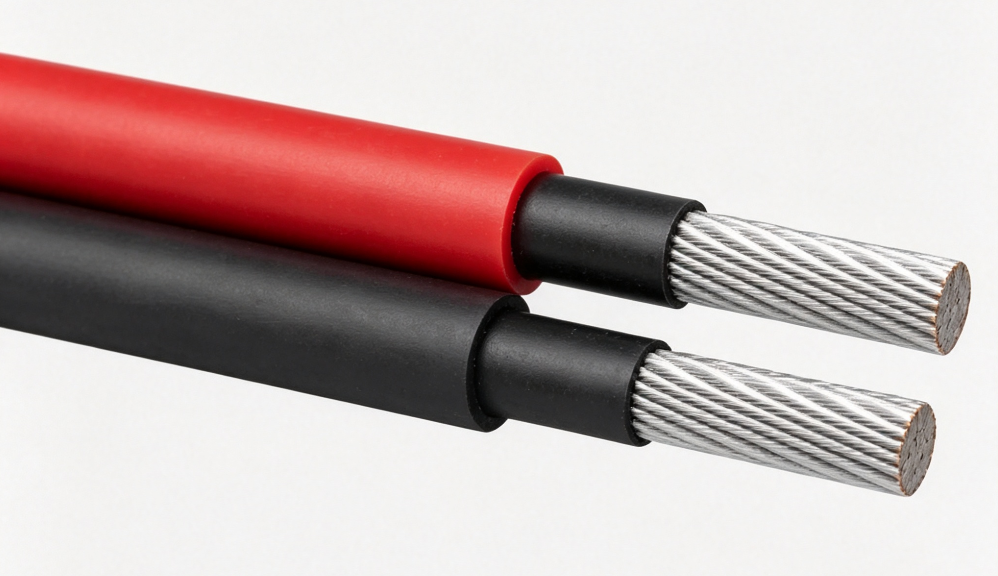
Solar Cables are developed for power transmission within photovoltaic systems, connecting solar panels, combiner boxes, inverters, and other system components. They are used in both rooftop and ground-mounted installations, supporting the transfer of direct current generated by solar modules under continuous outdoor exposure.
These cables are manufactured with insulation and sheathing materials selected to handle environmental influences such as sunlight, temperature variation, and mechanical stress. Flexible conductor designs simplify installation, while stable electrical characteristics support long-term operation in solar power systems. Solar cables are suitable for use in residential, commercial, and utility-scale photovoltaic projects where consistent performance and structural reliability are required.

1996
160000㎡
10+Years
No.33+
For B2B solar project procurement, a TUV Certified Solar PV Cable should be evaluated as part of the complete photovoltaic system rather than simply as an electrical accessory. PV cables are exposed to outdoor conditions for extended periods, often under UV radiation, temperature fluctuations, moisture, and mechanical stress. Certification can provide buyers with documented evidence that the cable has been assessed against specified technical and safety requirements, while the project specification should still define the exact cable construction and applicable certification scope.
For distributors, EPC contractors, solar module manufacturers, and system integrators, certification documentation can also simplify supplier qualification. Before placing a large order, procurement teams should verify the certificate number, applicable product designation, rated voltage, conductor construction, insulation and sheath materials, test requirements, and whether the certification applies to the exact cable model being purchased.
A Solar Cable installed on a photovoltaic system may remain outdoors for many years. Continuous exposure to sunlight can affect polymeric insulation and sheath materials if they are not appropriately designed for the application. UV exposure can contribute to material degradation, surface cracking, loss of mechanical properties, and reduced protection of the electrical components over time.
For commercial and utility-scale solar installations, cable durability should therefore be considered over the expected service period rather than only during initial commissioning. Buyers should review the manufacturer's technical documentation for UV resistance, temperature characteristics, environmental performance, and applicable testing. Installation conditions should also be considered because cable exposure can vary depending on whether the cable is installed directly beneath modules, on cable trays, in conduits, or in other protected locations.
Temperature is an important consideration when sizing and selecting a Solar Cable. PV modules and cable surfaces can become significantly warmer than the surrounding air under direct sunlight. At the same time, current flowing through the conductor generates additional heat. The cable therefore needs an appropriate thermal rating for the expected operating environment.
For B2B solar projects, cable selection should consider the maximum expected ambient temperature, cable installation arrangement, current loading, conductor cross-sectional area, and grouping conditions. Several cables installed closely together can also experience mutual heating. If thermal conditions are underestimated, the actual operating temperature may exceed the assumptions used during system design.
| Temperature factor | Potential impact on cable selection |
| High ambient temperature | Reduces thermal margin and may require derating |
| Direct solar exposure | Raises cable surface temperature |
| Multiple cables grouped together | Increases mutual heating |
| High current loading | Increases conductor heat generation |
Conductor cross-sectional area influences current-carrying capacity, voltage drop, electrical losses, cable weight, and procurement cost. For large solar farms, even a small difference in electrical loss can become commercially relevant when multiplied across long cable routes and thousands of operating hours.
B2B buyers should therefore avoid selecting cable size solely according to the maximum current shown in a basic product datasheet. The complete system design should consider cable length, operating current, temperature, installation method, grouping, allowable voltage drop, and applicable design requirements. A larger conductor may reduce electrical losses, but it also increases material consumption and installation costs, so optimization is normally preferable to simply oversizing every circuit.
Solar PV cables are frequently routed along module frames, mounting structures, cable trays, and other support systems. Although the cable is not normally subjected to continuous heavy mechanical loads, repeated movement caused by wind, thermal expansion, installation handling, and contact with support structures can create long-term mechanical stress.
Cable routing should prevent unnecessary tension, sharp bends, abrasion, and unsupported cable spans. Appropriate clips, cable ties, trays, and other management systems should be used without creating excessive compression on the cable sheath. For large-scale installations, installation workmanship can have a substantial effect on the long-term reliability of an otherwise correctly specified Solar Cable.
A PV cable does not operate independently. It must be connected to modules, junction boxes, inverters, combiner boxes, and other electrical equipment. Connector compatibility is therefore an important part of system design. Differences in conductor size, insulation diameter, contact dimensions, crimping requirements, and approved cable ranges can affect connection quality.
For B2B procurement, buyers should establish compatibility requirements before ordering large cable quantities. If the cable is supplied with connectors or prepared cable assemblies, the supplier should receive the relevant connector model, conductor specification, cable outer diameter, required cable length, termination method, and testing requirements.
| Interface item | Information to confirm |
| Conductor | Material, cross-sectional area, and strand construction |
| Cable diameter | Compatibility with connector sealing and crimping components |
| Connector | Specified connector model and approved cable range |
| Termination | Crimping tools, procedures, and required inspection |
Solar installations can contain extensive cable networks across rooftops, industrial facilities, utility-scale sites, and energy storage areas. Depending on the project, cable material and fire performance may be subject to specific engineering or regulatory requirements. Flame-retardant characteristics can be particularly relevant where cable routes pass through buildings or enclosed spaces.
Buyers should distinguish between general flame-retardant performance and other fire-related requirements such as circuit integrity during fire exposure. The appropriate requirement depends on the installation and applicable project standards. A detailed procurement specification should state the required performance rather than assuming that every certified Solar Cable provides identical fire characteristics.
Wuxi Xinyu Cable Co., Ltd. has developed a product portfolio covering eight major categories and more than 500 varieties, including polyvinyl chloride insulated wires, all-plastic power cables, all-plastic control cables, cross-linked power cables, computer cables, flame-retardant and fire-resistant power cables, flame-retardant and fire-resistant cross-linked power cables, and shielded cables. This broad product range demonstrates the company's experience across different cable construction requirements.
For distributors, EPC companies, solar project developers, and system integrators, purchasing decisions should be based on a complete technical and commercial package. A low unit price may not represent the lowest total project cost if the cable has unsuitable dimensions, inadequate environmental performance, incomplete documentation, or compatibility issues with the installation system.
Wuxi Xinyu Cable Co., Ltd. was established in 1996 and operates on a site exceeding 160,000 square metres, including 36,000 square metres of production facilities. The company has substantial manufacturing resources to support its diversified cable business. For B2B buyers evaluating a TUV Certified Solar PV Cable, these manufacturing resources, product range, technical documentation, and certification status should be evaluated together rather than relying on a single purchasing criterion.
Large solar projects and distributor programs may involve repeated cable orders over several months or years. Maintaining consistent specifications between batches is important because changes in conductor dimensions, insulation materials, outer diameter, or connector compatibility can create installation and quality-control issues. Procurement teams should establish an approved technical specification before mass production and clearly define any permitted changes.
A manufacturer with broad production capabilities can also be useful when a buyer needs different cable configurations for multiple project types. Wuxi Xinyu Cable Co., Ltd. combines a manufacturing site exceeding 160,000 square metres Its eight major product categories and more than 500 varieties provide a broad foundation for supplying different electrical cable requirements.
For B2B buyers, the objective should be to establish a repeatable procurement system covering certified products, technical specifications, quality documentation, batch consistency, packaging, and delivery. This approach can help reduce specification changes and improve efficiency when sourcing Solar Cable for multiple photovoltaic projects.

Ready To Customise
Your Cable Products?

 +852-68552081


 Language

 English
 русский
 Español
 عربى
عربى